

Adexa Genie© Predictive & Prescriptive Planning Agents
Your smart agents for Risk-resilience and agility
Even though AI technology has been with us for decades, only now can we apply them to business functions, thanks to faster processors and availability of memory for big data.
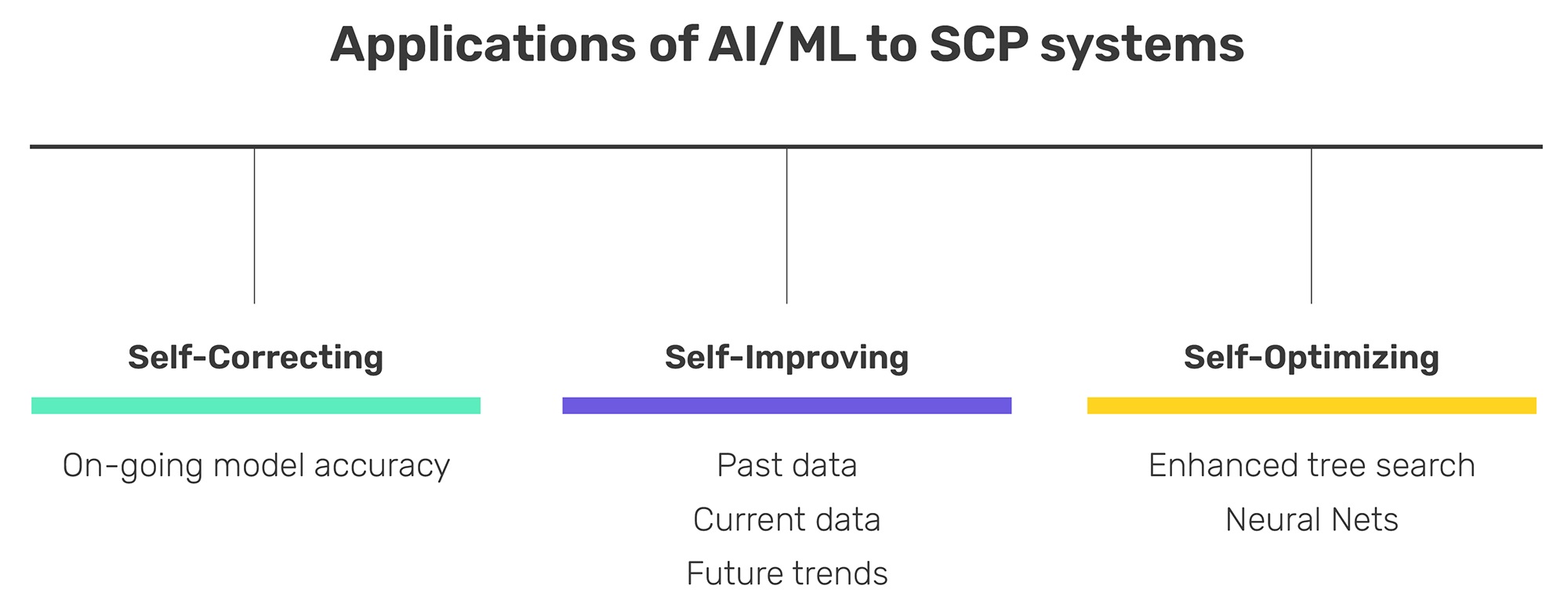
Using ML, a system can be trained to predict potential issues and make recommendations to prevent unwanted outcome, to create opportunities and/or to enhance the desired results. Thus, unnecessary risk is avoided, resilience is highly increased and potential disasters are predicted and prevented. Adexa accomplishes this using a digital twin of planning as outlined below. Agents are created to learn and act in order to make higher quality decision making in real-time making the supply chain more agile and resilient by removing unnecessary risk.
Self-Correcting uses past data in order to find trends that are changing the assumed model of the supply chain and constantly corrects original assumptions regarding (say) equipment efficiencies or supplier leadtimes etc. thus producing reliable commit dates and accurate financials for a more resilient supply chain.
Self-Improving uses past and future (or planning) data to identify frequency of issues and how to improve supply chain policies. A good example is Adexa ML technology to learn optimal levels of safety and hedge stocks.
Self-Optimizing means the ability of algorithms themselves to self-improve their performance and efficiency
Use of attributes as AI expert systems
Adexa attributes and Attribute Based Planning is used to learn business rules from the users and planners. The attributes form Boolean expressions that define such business rules. Thus, as the business processes and priorities change, the system keeps adapting and captures the new processes as they change.
Who is Q
Q is a distributed intelligent agent (process) that constantly runs to perform a specific set of business processes. Each Q is responsible for a specific task or business process forming an agent of its users.



Get in touch
Need more information?